We often see routine inquiries turn out to be biohazard engagements, highlighting exactly when to escalate cleaning safely. Buyers rarely understand the strict legal difference during an initial phone call. Proper triage at the intake stage prevents unsafe working conditions later.
Our team relies on a specific checklist to catch these red flags early. Most calls still resolve cleanly inside our deep cleaning and sanitization coordination — the escalation path only kicks in when a visible threshold is crossed.
This guide breaks down the critical components of a safe escalation:
- Visible and hidden triggers that mandate a specialty crew.
- Specific homeowner quotes that signal a larger problem.
- The exact handoff protocols and pricing adjustments.
Clear protocols protect the crew and the property owner. We map out exactly how to manage the homeowner conversation and the cost changes that follow.
Visible Escalation Triggers
Surface-level dirt wipes away easily. Biological material requires strict legal compliance.
Our technicians immediately stop standard work if they spot signs of dangerous contamination. Visual clues provide the fastest way to categorize a job. Checklists remove the guesswork from the inspection process.
We train teams to look for very specific thresholds.
- Saturation patterns on flooring or walls suggesting moisture and biological overlap.
- Sustained odors that ignore standard ventilation efforts.
- Visible mold colonies spreading across multiple surfaces.
- Active pest colonies at scale, rather than just perimeter activity.
- Structural staining that hints at deep wall-cavity contamination.
- Persistent smells surviving an initial round of basic cleaning.
Federal law steps in when bodily fluids are present. OSHA standard 29 CFR 1910.1030 dictates that bloodborne pathogens require specialized waste disposal.
Our protocol strictly follows the Environmental Protection Agency (EPA) mold remediation guidelines. The EPA states that any mold growth exceeding 10 square feet requires professional containment. This Action Level 2 threshold demands heavy-duty negative air pressure systems.
We cannot assign a standard maid service to these environments. Seeing two or more of these signs changes the scope entirely. The project immediately shifts from a deep clean to a biohazard or hoarding-cleanup engagement, drawing a strict line in the deep clean vs biohazard debate.
Hidden Triggers

Our project managers utilize specialized diagnostic tools to find hidden dangers. Some hazards remain completely invisible until the deep-clean walkthrough or mid-job inspection. These concealed threats present massive liabilities.
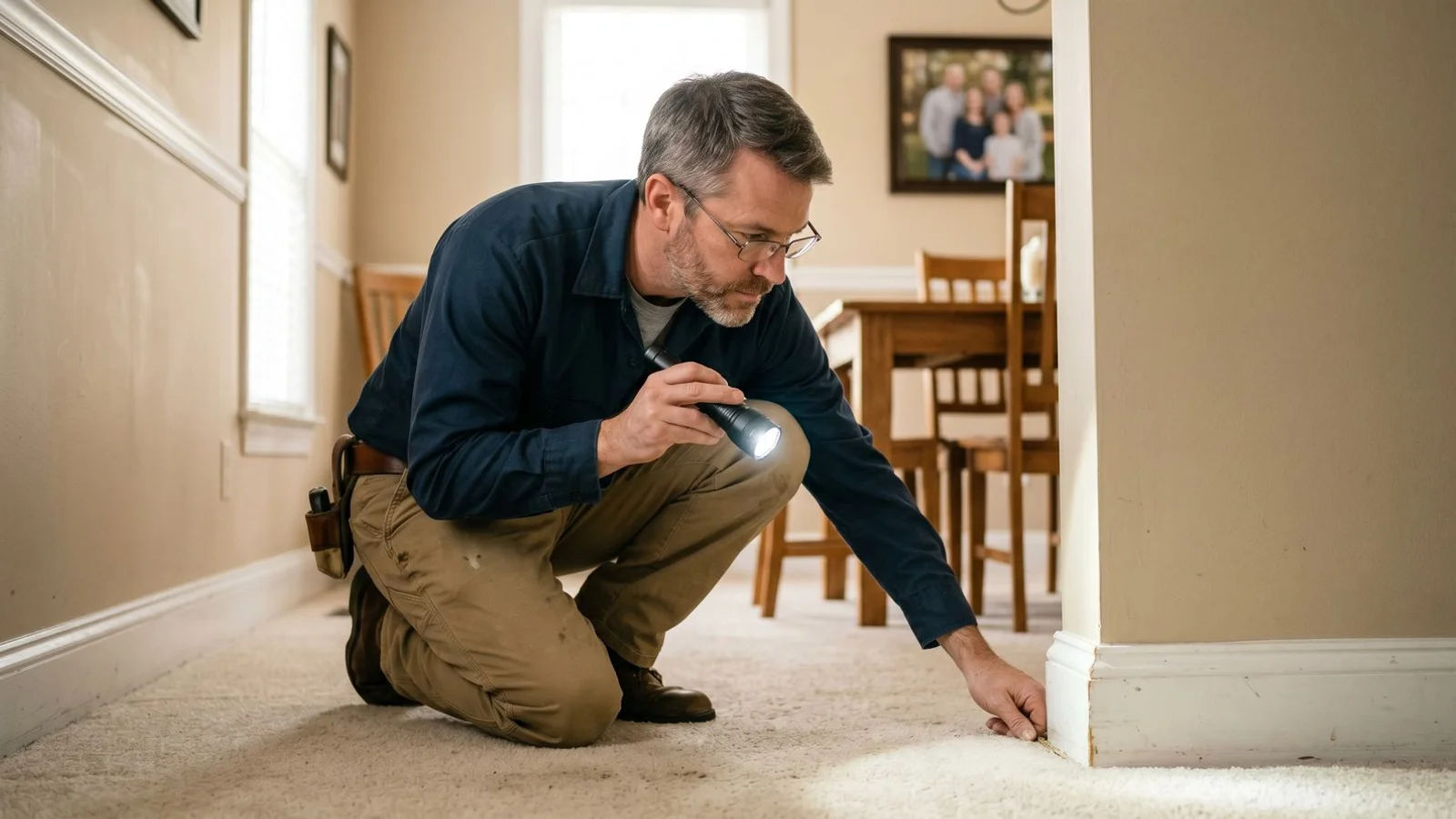
We know that removing baseboards or lifting carpets often exposes a completely different reality.
- Subfloor saturation beneath affected rooms that remains invisible until baseboard removal.
- Wall cavity contamination requiring invasive inspection or thermal imaging.
- Odors migrating through ductwork from upstream HVAC contamination.
- Hidden moisture damage trapped under flooring or inside attic spaces.
- Decomposition residue hidden beneath heavy furniture or inside walls.
Finding moisture fast saves hours of guesswork. The FLIR MR277 thermal imaging moisture meter is a perfect example.
Our specialists rely on its Infrared Guided Measurement (IGM) to visually highlight subfloor saturation. Mold or biological matter inside the HVAC system requires extensive source removal. The National Air Duct Cleaners Association (NADCA) ACR standards dictate these procedures.
Diagnostic Tools and Safety Mandates
We strictly follow these guidelines for unseen duct issues. Pushing forward with a standard clean compromises safety. Honest communication prevents massive health risks for the occupants.
Our providers must pause and re-route the service when encountering these hidden issues. The property owner deserves a proper remediation plan. Rushing the job only leads to secondary damage.
We always choose safety over a quick turnaround.
Homeowner-Reported Red Flags
Clients often downplay the severity of the mess during phone triage. Specific phrases from the homeowner strongly signal a scope beyond deep cleaning.
Our intake staff must listen closely to the exact phrasing used. Verbal cues help pivot the conversation toward specialty remediation. A long-term pet accident usually means ammonia has penetrated the subfloor.
We map these statements directly to action plans.
- ”There was a leak under the sink for years and we just discovered it."
- "My pet had accidents in this room for a long time."
- "Someone passed away in the home."
- "I am trying to get the smell out and nothing has worked."
- "The carpet looks fine but the room smells off.”
Each of these scenarios requires a completely different approach than a standard surface scrub. The intake conversation acts as the primary defense against misquoting a job.
Our teams categorize these statements into specific escalation paths. An unattended death immediately triggers a Biosafety Level 2 (BSL-2) or higher protocol. Strict adherence to these rules prevents dangerous exposure.
| Homeowner Statement | Hidden Reality | Required Escalation |
|---|---|---|
| ”A leak ran for years.” | Category 3 water damage and Action Level 2 mold. | Structural remediation and mold abatement. |
| ”Long-term pet accidents.” | Subfloor saturation and deep bacterial growth. | Subfloor sealing and biohazard extraction. |
| ”Someone passed away.” | Bloodborne pathogens governed by OSHA 29 CFR 1910.1030. | Certified trauma and crime scene cleanup. |
| ”Nothing fixes the smell.” | HVAC system contamination or wall-cavity mold. | NADCA-certified duct cleaning or demolition. |
We listen for these exact triggers every single time the phone rings.
How the Platform’s Escalation Handoff Works
Smooth transitions keep the client calm while securing the right level of service. Safety remains the top priority during this phase.
Our team follows a strict five-step routing procedure to handle these escalations.
The Five-Step Routing Process
- Confirm the specific escalation triggers during the initial intake call.
- Explain the scope difference to the homeowner without causing alarm.
- Route the job to the appropriate provider tier for biohazard or hoarding cleanup.
- Coordinate insurance involvement based on specific policy types.
- Follow up after the work concludes to ensure complete satisfaction.
Standard homeowners insurance policies, like the common HO-3 form, often cover trauma cleanup under personal property protection. Gradual damage from a long-term leak rarely qualifies for coverage.
We actively guide the homeowner through the insurance maze during step four. Mid-job escalations trigger the exact same handoff sequence. The deep-clean provider simply stops working to comply with the Institute of Inspection, Cleaning and Restoration Certification (IICRC) S500 standard for category 3 water loss.
Our dispatchers then coordinate the cross-route to a certified specialty crew.
What Changes About Cost and Timeline
Scope expansion heavily impacts both the budget and the project calendar. Standard deep cleaning relies on simple hourly labor and basic supplies.
We prepare clients for these realities immediately.
- Per-square-foot cost typically increases 3 to 10 times for biohazard work.
- Timeline extensions add 3 to 7 days for proper containment setup and verification testing.
- Documentation requirements expand heavily for insurance claims and real estate disclosures.
- PPE and specialty equipment add massive overhead to the labor rates.
Biohazard remediation requires heavy-duty personal protective equipment and expensive disposal fees. Total trauma cleanups routinely range from $3,000 to $5,000 due to BSL-2 requirements.
Our data from 2026 shows a stark contrast in pricing across the United States. A standard deep clean might cost $0.15 to $0.50 per square foot. Biohazard containment costs jump to $15 to $30 per square foot.
Managing the Financial Shock
We rely on that critical five-minute intake conversation to avoid pricing shocks. These numbers only cause panic when scoped incorrectly by an untrained agent. Proper identification protects the client’s wallet and the crew’s health.
We encourage property managers to review the full details online. For the side-by-side comparison, see biohazard vs deep cleaning, or visit deep cleaning coordination. Clear expectations make the entire process safer for everyone involved.