
We all know the frustration of paying for a service, only to realize the real problem was barely scratched.
The confusion between biohazard cleanup vs deep cleaning happens entirely too often.
Picking the wrong service wastes money and exposes occupants to lingering safety risks. The dividing line is actually very clear.
Our team will break down the exact differences in training, equipment, and pricing.
You can then use this verifiable data to make the right choice for your property. If the situation crosses into regulated waste or PPE territory, our biohazard and specialty cleanup coordinators handle the routing.
Definitions in Plain Language
Our field technicians define the difference between biohazard cleanup vs deep cleaning by looking at the specific goal of the process.
Standard deep cleaning removes visible dirt, grime, and surface-level messes using commercial-grade products. Biohazard cleanup tackles dangerous biological, chemical, or structural contamination that threatens human health.
We adhere to the OSHA Bloodborne Pathogens Standard, specifically 29 CFR 1910.1030, for these hazardous jobs. This federal regulation dictates exactly how workers must handle potentially infectious materials.
Contamination sites require verified pathogen control rather than just a quick visual wipedown. These hazardous sites present three main challenges:
- Pathogen Control: Eliminating invisible viral and bacterial threats.
- Cross-Contamination: Preventing the spread of disease to clean areas.
- Structural Damage: Removing fluids that have soaked into building materials.
Our protocols address all three of these severe risk factors. Standard deep cleaning simply is not built for biological residue or serious infection control.
Certifications and PPE Differences
We require vastly different protective gear and training for these two service tiers.
Standard cleaning relies on basic work gloves and standard face coverings. Hazardous environments demand full-body protection like sealed DuPont Tyvek suits.
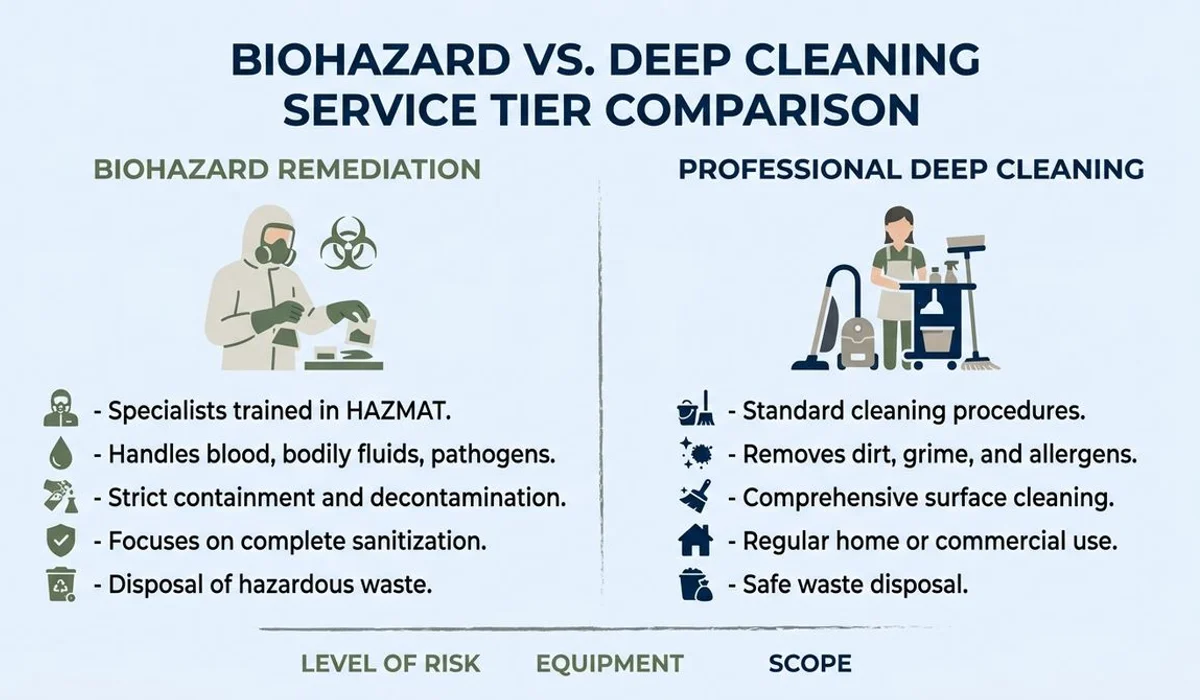
| Standard Deep Cleaning | Biohazard Cleanup |
|---|---|
| Standard work gloves | N100/P100 respirators, DuPont Tyvek suits |
| Commercial cleaning chemicals | EPA-registered disinfectants with kill claims |
| General trash disposal | Licensed regulated-waste haulers |
| Visual confirmation | ATP testing and air-quality verification |
| Light containment | Negative-pressure containment, dedicated PPE staging |
| No certifications required | IICRC TCST, OSHA-aligned training |
Our specialized crews also wear N100 or P100 respirators to block 99.9 percent of airborne particles.
A standard N95 mask simply does not offer enough protection against aerosolized bloodborne pathogens. Proper training is just as crucial as the physical gear.
We send our biohazard teams through the IICRC Trauma and Crime Scene Technician certification process.
This ANSI/IICRC S540 standard teaches technicians how to safely execute trauma scene decontamination. It requires rigorous testing to ensure workers understand complex biohazard control.
Chemicals Used
We select chemicals based on the exact biological threat present in the building.
Standard deep cleaning utilizes quaternary ammonium and basic hospital-grade disinfectants for everyday sanitization. Biohazard work demands specific products pulled directly from the US EPA registered disinfectants lists.
Our technicians frequently use industrial biocides like Nisus DSV or Benefect Botanical Disinfectant.
The selection is never interchangeable. Different formulas treat blood, animal waste, and mold contamination.
Here are a few key distinctions in chemical usage:
- EPA List N Products: Required for destroying resilient viral strains.
- Botanical Disinfectants: Products like Benefect kill pathogens quickly without requiring heavy protective gear for the user.
- Wet Dwell Times: Disinfectants must often sit visibly wet on a surface for a full 10 minutes to ensure a complete kill.
We mandate these strict contact times to guarantee the destruction of dangerous microscopic pathogens.
General cleaning sprays evaporate too quickly to achieve this level of safety.
Disposal Differences
We treat waste removal as a highly regulated safety procedure during hazardous jobs.
Standard cleanup waste goes straight into the general municipal trash bins. Hazardous biological materials qualify as regulated medical waste under US federal law.
Our teams seal these contaminated materials inside heavy-duty red biohazard bags.
These bags then go into rigid, leak-proof containers for safe transport. Licensed haulers must transport this material according to US Department of Transportation hazmat regulations.
We secure a chain-of-custody manifest for every single container leaving your property.
This legal document proves the dangerous waste was destroyed at an approved incineration facility. A standard cleaning service lacks the legal authority to transport these restricted materials.
Post-Clean Verification
We use scientific testing to prove a hazardous site is safe for human occupation.
Standard deep cleaning verification happens through a basic visual inspection and walkthrough. A surface might look perfectly clean to the naked eye while still harboring dangerous bacteria.
Our safety officers utilize Hygiena ATP testing meters to detect microscopic organic matter.
These devices measure cellular energy in Relative Light Units, commonly called RLUs.
Scientific verification includes three crucial steps:
- ATP Swab Testing: Instantly quantifies the presence of living cells on a surface.
- RLU Benchmarks: A sanitized surface must typically score under 30 RLUs to pass inspection.
- Air Quality Monitoring: Ensures aerosolized particles have been completely filtered out.
We document these specific testing metrics in a final written summary for the property owner.
This concrete data allows a homeowner to confidently reoccupy the space or list the property for sale.
Price Difference
We provide highly detailed estimates because the cost gap between deep cleaning vs biohazard remediation is significant.
Standard deep cleaning typically costs between $0.50 and $2.00 per square foot for restoration-grade scope. In 2026, professional biohazard cleanup generally runs from $15 to $30 or more per square foot for the affected area.
| Service Tier | Average Cost Per Sq Ft | Typical Project Total | Disposal Considerations |
|---|---|---|---|
| Standard Deep Clean | $0.50 - $2.00 | $200 - $600 | General trash |
| Biohazard Cleanup | $15.00 - $30.00+ | $1,500 - $5,000+ | $50 to $250 per hazmat bin |
Our pricing models must account for expensive disposal fees, strict PPE requirements, and specialized labor.
The right scope of work is rarely the cheaper option up front. Choosing standard cleaning for a biohazard issue often costs more in the end due to required re-do work.
We frequently work directly with homeowners insurance companies to cover these major expenses.
Most standard policies cover biological contamination caused by accidents or covered perils.
How We Decide Which to Refer
We employ a rapid phone triage system to recommend the exact right service for your situation.
Picking the wrong service tier wastes time and exposes occupants to unnecessary risks when deciding between a biohazard or deep clean. The triage process analyzes four specific warning flags.
- Visual cues: Heavy biological contamination, extensive mold, or deep structural staining.
- Odor signature: Sustained decomposition smells require specialized ozone treatments, unlike addressable pet odors.
- Structural saturation: Fluids that seep into subflooring, drywall, or HVAC systems mandate targeted demolition.
- History: Unattended deaths, significant animal waste, or water-and-bio overlaps automatically elevate the risk.
We route the project to a specialized biohazard team when two or more of these flags trigger.
Standard deep cleaning is the right call when none of these severe hazards are present.
For specific escalation guidance, see when deep cleaning isn’t enough. You can also visit our biohazard cleanup coordination page for complex situations.
Conclusion
We hope this breakdown clarifies the crucial differences between biohazard cleanup vs deep cleaning.
Taking the time to assess the situation correctly will protect your health and your wallet. Always prioritize safety over savings when dealing with potential contamination.
Our team is ready to answer any specific questions about your property.
Contact us today to schedule a thorough assessment and get the right cleaning process started.