
Our property restoration professionals regularly hear from families trying to define what is hoarding disorder levels and how it impacts a home. The situation goes far beyond standard messiness. It involves a recognized mental health condition that alters how a person relates to their possessions.
We rely on the 5-level Clutter Hoarding Scale to give families a factual, judgment-free vocabulary. Developed by the Institute for Challenging Disorganization, this framework helps professional cleanup teams describe severity accurately.
Let’s look at the clinical data, break down the specific scale levels, and explore practical ways to respond.
A Plain-Language Definition
Our property restoration teams define this condition as a recognized mental health disorder, not just a cleaning problem. The American Psychiatric Association specifically lists it as a distinct diagnosis in the DSM-5-TR. Research from 2025 indicates that approximately 2.6 percent of the US population deals with this condition.
We often remind clients that this translates to roughly one in forty adults nationwide. Hoarding disorder involves three persistent features that go beyond simply needing to clean up. These core traits include difficulty discarding items, intense distress around removal, and severe living space compromise.
- Difficulty discarding: Possessions feel necessary to save, even when they appear to others to have no value.
- Distress around removal: Actual or anticipated loss of possessions causes significant emotional discomfort.
- Living space compromise: Accumulated possessions clutter rooms to the point that they cannot be used for their intended purpose.
Our teams frequently see how overlapping mental health challenges complicate the situation. A 2026 review published by the International OCD Foundation notes that nearly 75 percent of individuals with this disorder also experience depression or anxiety. Understanding these psychological dimensions reframes the conversation in a way that almost always helps.
The 5-Level Clutter Hoarding Scale
We use the Clutter Hoarding Scale to assess safety and sanitation independently of psychiatric diagnosis. The Institute for Challenging Disorganization created this observational guideline tool. According to recent 2025 updates, the scale focuses entirely on the functionality of the residential environment.
Our project managers rely on these five levels to communicate clearly with families and local social workers. The framework provides a neutral, objective way to categorize the volume of clutter and potential health risks. You can review the visual guide below before reading the detailed breakdowns.
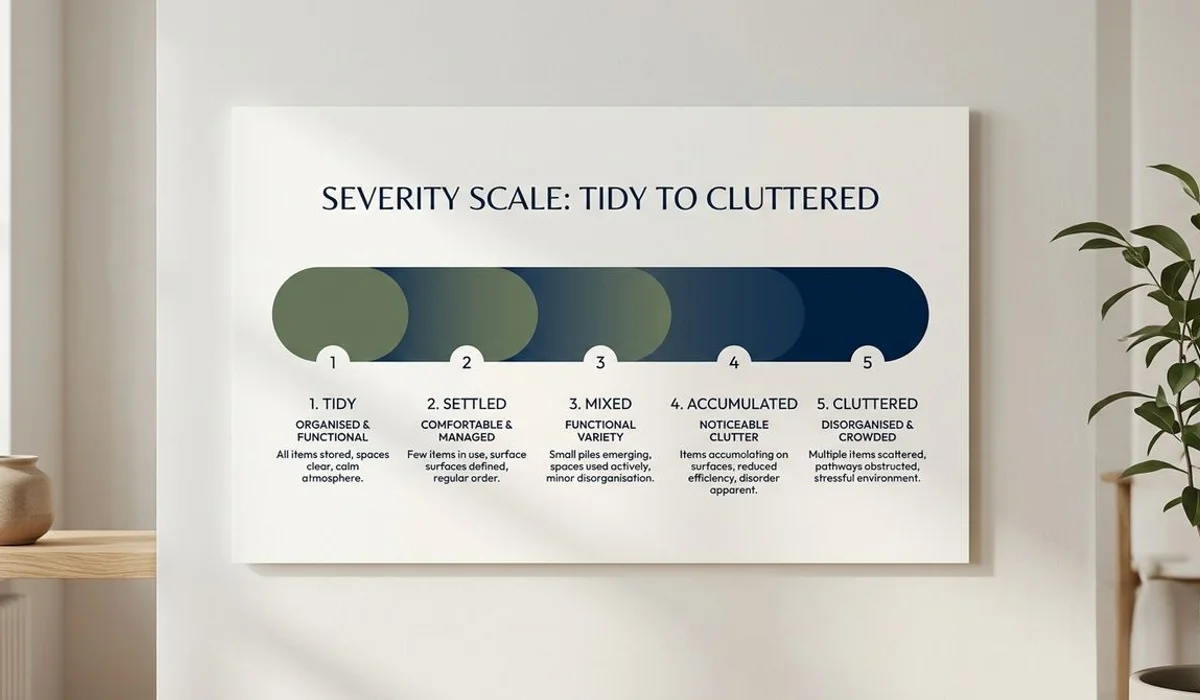
Level 1: Mostly Organized
We rarely receive calls for this baseline level. A Level 1 home represents a normal household with minor clutter where all rooms are used as intended. There are absolutely no sanitation issues or pest infestations present.
Our field technicians find that family help or a one-time decluttering session is usually enough to restore order. Doorways and stairways remain fully accessible for daily use. The environment requires no special knowledge in working with chronic disorganization.
Level 2: Visible Clutter
We typically advise that Level 2 involves structured support and consistent patience. At this stage, you will see visible clutter from the outside if windows are exposed. Some rooms become harder to access, and light hygiene concerns begin to appear, including:
- Dirty dishes piling up.
- Overflowing garbage cans.
- One major appliance breaking down.
Our crews often observe these specific warning signs early in the process. Action must be taken before pest issues start. A dedicated home decluttering effort is still possible here with the right game plan.
Level 3: Heavy Clutter, Structural Items Blocked
We view Level 3 as the definitive pivot point where compassionate professional cleanup becomes the right path. At least one room is entirely unusable for its intended purpose. Visible clutter spills outside onto porches or garages, and pet waste or pest evidence usually becomes apparent.
Our technicians require specialized training to safely work inside these elevated household environments. You might notice blocked exits or plumbing systems that are not fully functional. The Institute for Challenging Disorganization strongly recommends involving a community network of resources, including mental health professionals, at this stage.
Level 4: Hazardous Conditions
We know from experience that Level 4 environments pose serious fire safety risks and major sanitation issues. Multiple rooms are unusable, exits are blocked, and structural damage often begins to surface.
“Professional sort-with-dignity protocols become absolutely necessary when structural damage and blocked exits appear.”
Our coordinators work with a collaborative team of service providers, such as pest control officers and licensed contractors, to handle these jobs. The average cost for a moderate to severe cleanup across the US typically ranges from $3,000 to $10,000 due to the required labor and disposal fees. Families should prioritize safety over trying to handle these hazardous conditions themselves.
Level 5: Severe Biohazard
We send specialized biohazard teams wearing full personal protective equipment to tackle Level 5 conditions. These homes feature a severe sanitation crisis, structural concerns, and significant animal waste contamination. Standard cleaning services cannot legally or safely manage this level of building integrity risk.
Our protocols strictly follow the OSHA Bloodborne Pathogens Standard to protect everyone involved. This federal regulation mandates the use of puncture-proof sharps containers and red biohazard bags for proper disposal. Professionals must also use secondary containment strategies to transport materials safely and prevent cross-contamination.
When Each Level Needs Help
Our standard recommendation is to rely on family support for Levels 1 and 2. For Level 3 and above, the physical and emotional dynamics drastically change. The disposal volume easily exceeds a weekend project, with standard landfill disposal fees often running $150 to $350 per load in the US.
We caution families that the relational damage from a forced DIY attempt can easily outlast the cleanup itself. Sorting decades of possessions requires more emotional labor than most relatives can comfortably sustain. Safety considerations like mold, structural damage, and pest infestations also enter the picture.
| Factor | DIY Cleanup (Levels 1-2) | Professional Cleanup (Levels 3-5) |
|---|---|---|
| Cost & Equipment | Basic household supplies and standard trash bags. | Industrial PPE, dumpsters, and OSHA-compliant biohazard bags. |
| Time Investment | A few weekends of dedicated family effort. | 1 to 5 days of intensive, specialized crew labor. |
| Emotional Strain | Manageable with patience and open communication. | High risk of relational damage without a neutral third party. |
Our network connects families with compassionate, trained providers who understand these structural and emotional hurdles. This is the point at which residents reach out to platforms like ours for compassionate hoarding cleanup across the Carolinas. The provider does the heavy lifting, while the family stays at the center of the decisions throughout the entire process.
Where to Go From Here
We hope this guide to hoarding levels explained provides the clarity you need to assess a property. If what you are seeing in a Carolinas home sits at Level 3 or above, the next step requires careful planning.
Please read our detailed guide covering the signs it’s time to get professional help. Our team is ready to provide a private, judgment-free conversation whenever you need support.
You do not have to fix this complicated situation alone.
Reach out today to schedule a confidential assessment.