Finding a loved one after an unattended death is one of the most paralyzing moments a person can experience.
From what we have seen, the shock often makes it impossible to know what to do next. The situation requires immediate, careful action to protect your health and the physical property.
We are going to break down the exact steps to take in those first critical hours.
Then, this guide will explain the medical examiner process and what professional unattended death decomposition cleanup actually involves. This work always routes through our biohazard and specialty cleanup coordinators, who handle insurance-aware paperwork and discreet on-site response.
In the First Hour
Your immediate priority is calling 911 so Emergency Medical Services (EMS) and local law enforcement can arrive. The police and medical personnel need an undisturbed scene to conduct their initial work.
Our team strongly advises against taking any photos beyond what the 911 dispatcher explicitly requests. Doing so can accidentally complicate police work or compromise a future insurance claim.
Here is the exact sequence you need to follow right now:
- Call 911 immediately if emergency services have not been notified.
- Do not enter the room, even for a few seconds.
- Keep pets and family members isolated to prevent tracking biological material through the house.
- Do not attempt any surface cleaning. Wiping surfaces or opening windows can spread aerosolized pathogens to clean rooms.
- Wait outside or in a separate space for law enforcement and the medical examiner to arrive.
They will take control of the scene and eventually release the property back to you. Until they give official clearance, no professional restoration work can begin.
Why Families Should Never DIY
Families should never attempt this cleanup because decomposition releases hazardous airborne pathogens and fluids that permanently penetrate floors and drywall. Proper remediation requires industrial chemicals and strict safety protocols to prevent severe illness.
We understand the natural instinct to clean the area before others see it. That well-meaning reaction is incredibly dangerous for several reasons:
- Microscopic biohazards: According to the Occupational Safety and Health Administration (OSHA), bloodborne pathogens like Hepatitis B and MRSA can survive on surfaces for over a week at room temperature.
- Ineffective household chemicals: Scrubbing a surface with retail bleach often just pushes these contaminants deeper into the wood grain or carpet padding.
- Hidden structural damage: Biological fluids frequently seep past the visible floorings and saturate the subfloor underneath.
Our technicians frequently see cases where a family’s DIY cleanup attempt ruins the property’s structural wood. When fluids reach those deeper layers, simple surface cleaning is useless.
Most insurance carriers also require documented remediation by a certified biohazard company. Attempting to handle a decomposition cleanup nc project on your own can result in a denied homeowner’s claim.
Coroner and Medical Examiner Sequencing
The cleanup company cannot start work until the local authorities officially release the property. This legal hold allows them to complete their necessary investigation and safely transport the deceased.
In North Carolina, the NC Office of the Chief Medical Examiner (NC OCME) takes jurisdiction. South Carolina handles this at the local county coroner level.
We wait on standby until their specific protocols are finished. This timeline typically takes anywhere from 12 to 48 hours, depending on the county’s current caseload.
Once the medical examiner formally releases the scene, the property owner can allow access. You can hand over the keys directly, or you can coordinate with a trusted neighbor to let the remediation team inside.
What Providers Do On-Site
A certified biohazard team will systematically seal the room, remove contaminated materials, and chemically disinfect the entire space. The goal is to return the environment to a safe, hospital-grade level of clean.
Our crews follow strict industry regulations to protect everyone involved in the restoration process. A standard death scene cleanup carolinas project follows a highly regulated sequence, split into two main phases.
Arrival and Containment
The initial steps focus on securing the environment and protecting the rest of the property.
- Discreet arrival: Teams use unmarked vehicles to protect your privacy in a residential neighborhood.
- Containment setup: Technicians use heavy 6-mil plastic sheeting and tape to seal off the affected area from clean rooms.
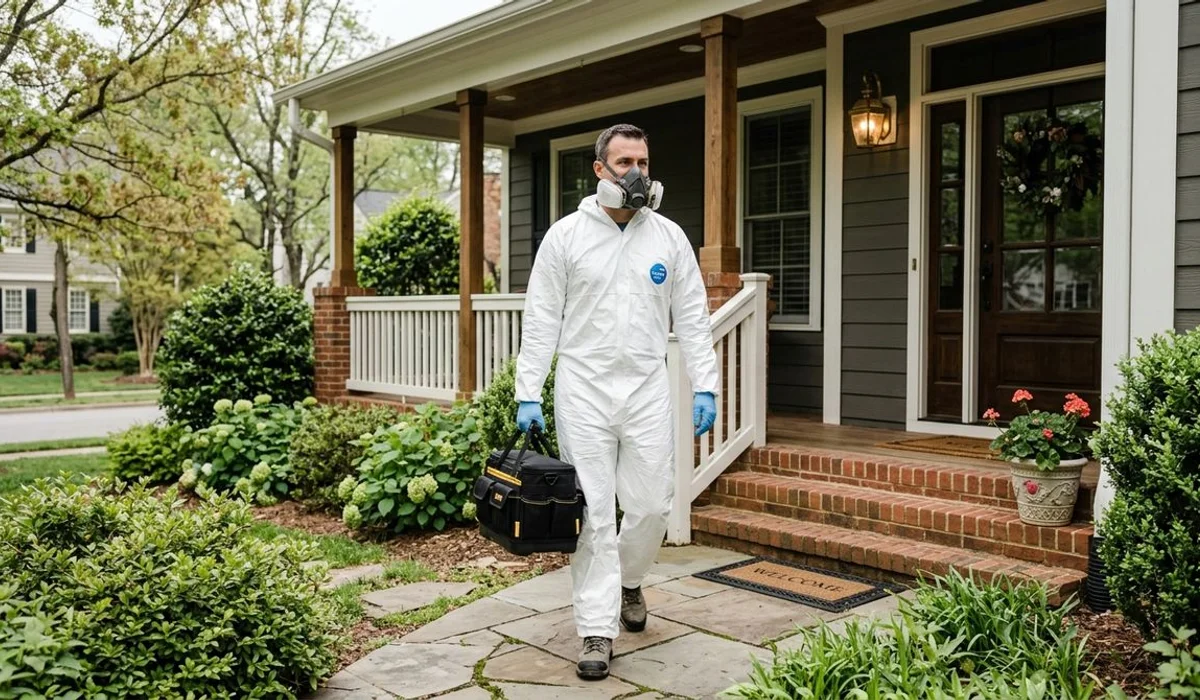
- Safety staging: The crew suits up in full Tyvek coveralls, sealed-seam booties, and full-face respirators before entering.
Decontamination and Verification
Once the area is isolated, the actual removal and cleaning work begins.
- Source removal: Workers remove saturated carpets, drywall, and even subfloor sections if biological matter has soaked through.
- Chemical disinfection: The team applies EPA-registered, hospital-grade disinfectants to all surrounding surfaces and HVAC vents.
- Air quality restoration: Commercial HEPA air scrubbers and hydroxyl generators run continuously to remove odor molecules and airborne bacteria.
- Scientific verification: We use Adenosine Triphosphate (ATP) fluorescence testing to prove the surface has a biological count of zero.
This physical labor usually spans one to three days. Projects take longer if extensive structural tear-out is necessary.
Dignity Protocols
Professional remediation crews operate under strict privacy and respect guidelines to shield the family from further distress. This means working quietly, protecting personal items, and strictly controlling who sees the scene.
We consider these unwritten rules just as vital as our technical safety standards. Reputable providers treat your privacy with the same strictness as HIPAA regulations in a hospital setting.
The standard compassion protocols include:
- Careful handling of belongings: Items near the deceased are cleaned with EPA-approved solutions if possible and securely held for the family.
- Strict media blackouts: Technicians never share photographs of the scene with anyone outside the insurance adjuster and the immediate work crew.
- Neighborhood discretion: Crews avoid parking large, flashing biohazard trucks in front of your home.
- Empathetic communication: The site supervisor speaks to the family using clear, patient language instead of cold medical jargon.
These measures give you the space to process the event without neighborhood gossip or unnecessary stress.
Insurance Coordination
Most standard homeowner insurance policies cover the full cost of biohazard remediation, minus your standard deductible. The cleanup company will usually document the damage and bill the insurance carrier directly to save you the financial stress.
We find that many people incorrectly assume they have to pay out of pocket for these emergency services. Under most policies, this incident falls under “Coverage A - Dwelling” or “Coverage C - Personal Property” as a sudden and accidental loss.
A successful claim typically covers several distinct remediation costs:
- Professional labor and dispatch fees
- Contaminated furniture and carpet removal
- Industrial cleaning chemicals and safety equipment
- Structural tear-out and subfloor replacement
The technicians will take specific photographs and write detailed scope-of-work reports formatted exactly the way your claims adjuster requires. Filing a claim for a trauma scene rarely impacts your future premiums.
For a deeper look into policy specifics, see this guide on insurance coverage for biohazard scenarios.
If you want to understand the technical chemicals and gear involved, you can review the biohazard PPE and process guide.
A Note to Families
You are not making the wrong choice by asking for professional help.
Trained specialists exist precisely so you do not have to carry this burden alone. Managing an unattended death decomposition cleanup is simply too physically and emotionally dangerous for a grieving family to handle.
Our team is ready to support you through this difficult transition.
The next step is to make one private phone call, and let us take care of the rest.