
We understand why so many families ask what is an estate cleanout when they first walk through the door of a filled home.
The demographic shift called the “Silver Tsunami” means over 11,200 Americans turn 65 every single day in 2026. Thousands of families find themselves in this exact position.
Our goal is to explore the true estate cleanout meaning so you can make informed decisions. Let’s look at standard inclusions, associated costs, and how it differs from other services.
A Working Definition: What Is an Estate Cleanout?
The standard estate clean out definition refers to the process of clearing a home, typically after a death, downsizing, or transition to assisted living. Our service definition includes sorting items, distributing or donating contents, hauling disposal, and preparing the property for sale, rental, or family handoff.
A typical American home occupied for decades contains roughly 300,000 individual items. Decision fatigue sets in incredibly fast when you tackle that volume alone.
We strongly recommend using full-service Carolinas cleanouts that bundle several steps together. These steps include sorting, documenting valuables, family review, donation routing, debris removal, and a basic post-clean.
What’s Usually Included
A comprehensive estate cleanout includes sorting belongings, coordinating donation pickups, hauling debris, and sweeping the emptied rooms. Our standard operations provide a dedicated crew to manage all the physical labor and heavy lifting.
The national average cost for these full services sits around $1,250 in 2026. Prices range from $500 for small apartments up to $4,000 for large homes depending on volume.
We ensure the provider handles the following core logistics from start to finish.
- Sorting items into keep, donate, distribute, and discard categories
- Documenting potentially valuable items for the executor
- Coordinating donation pickups with local 501(c)(3) partners
- Hauling debris in standard truckload increments
- Performing a basic post-clean of emptied rooms
- Conducting the final walkthrough and sign-off
Standard junk removal loads average $200 to $600 each depending on the region. These hauling fees factor into the total budget.
What’s Usually Separate
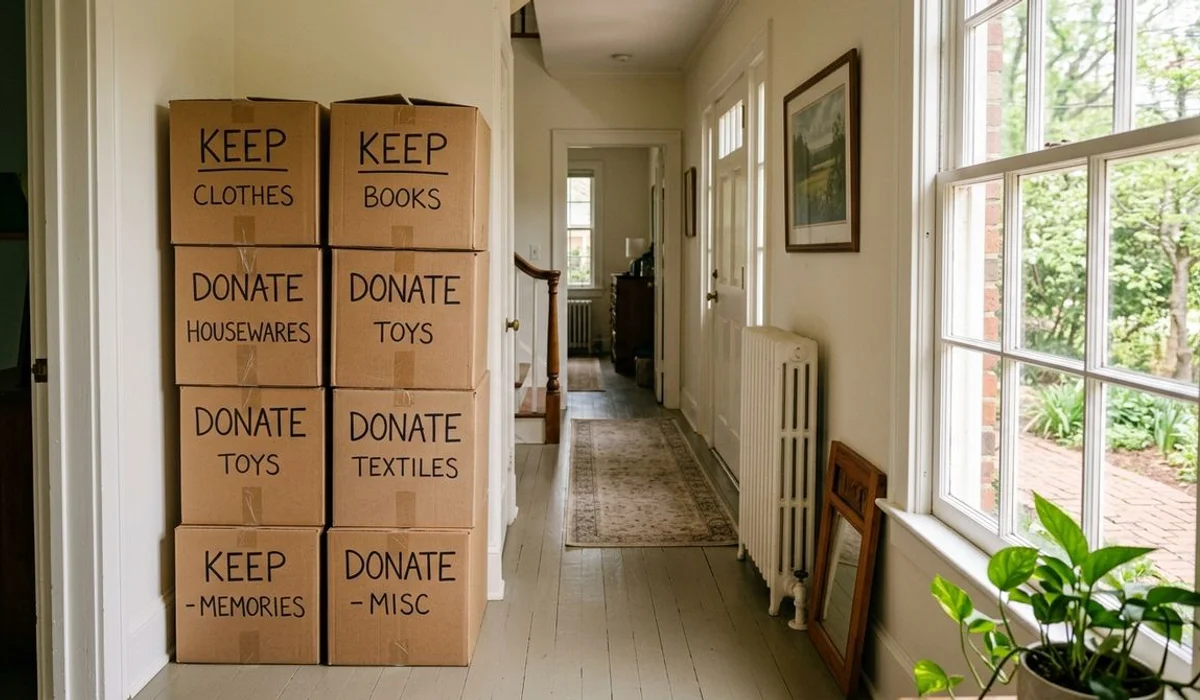
Our providers focus exclusively on the core clearing phase. Specialized tasks like estate sales, legal probate inventory, deep cleaning, and biohazard remediation fall outside a standard cleanout. You will need different professionals for jobs that require legal certification or specialized licensing.
We use clear boundaries to protect the estate from liability risks and unexpected fees.
| Service | Who Handles It | 2026 Context & Details |
|---|---|---|
| Estate sale | Liquidator / Estate Sale Company | Professionals typically charge a 35% to 50% commission out of gross proceeds. |
| Probate inventory | Executor / Probate Attorney | North Carolina requires the AOC-E-505 inventory form filed within 90 days. |
| Restoration deep cleaning | Specialized Cleaning Service | This readies properties heading to the MLS or removes stubborn odors. |
| Repairs and listing prep | Licensed General Contractors | Cleanout crews do not handle drywall patching, painting, or fixture updates. |
| Biohazard remediation | Certified Cleanup Teams | This separate scope applies to heavy hoarding-density or post-decomposition conditions. |
These divisions keep your timeline on track. Certain situations demand expert handling to avoid legal trouble.
Triggers That Lead to Estate Cleanouts
We frequently see families initiate an estate cleanout after a major life transition, such as a death or a sudden move to assisted living. Other common triggers include severe downsizing needs, foreclosures, or preparing an inherited property for liquidation.
Recent real estate data shows that over 340,000 inherited homes changed hands nationwide leading up to 2026. Our clients tell us the holding costs on those vacant properties add up painfully fast.
Care facilities also enforce tight deadlines, often requiring a deposit within 48 to 72 hours of a bed opening. The most common triggers include the following events.
- Death of the homeowner
- Move to assisted living or with family
- Foreclosure or short sale
- Downsizing in retirement
- Inherited property the heirs need to liquidate
We recognize how much pressure these deadlines place on executors. Removing the property contents quickly stops the financial bleeding.
Where Carolina Hoarding Cleanup Fits
The role of a referral coordinator is to bridge the gap between overwhelmed families and capable crews. We connect families and executors across NC and SC with vetted local providers who handle estate cleanouts compassionately. The platform matches your specific property needs with the right equipment and trucks.
Local partners execute the physical work on site. Our team does the intake, the match, and the follow-up. This centralized support structure removes the guesswork from finding reliable help.
For a side-by-side comparison to help you fully grasp what is an estate cleanout, see estate cleanouts vs estate sales, or visit our estate cleanout coordination service for the full hub.