
Our professional service team often guides families through the heavy emotional toll of relocating an older relative. When sorting belongings, senior compassion is the most important tool you can bring to the table. Decades of family photographs, gift letters, and children’s artwork carry intense sentimental value.
We know these objects represent an entire lifetime of memories. A recent 2026 Grow Therapy report found that 39% of grieving Americans feel entirely disconnected or numb during major life transitions.
Sorting through a house full of items often compounds this profound grief.
Our coordinators want to offer a better way forward. Let’s look at the specific frameworks that actually work in practice, and then explore practical ways to reduce the burden.
Family-Led vs Provider-Supported
We find that deciding between family-led and provider-supported sorting depends entirely on your timeline, emotional bandwidth, and the sheer volume of items. Assessing the physical and relational capacity of everyone involved is the crucial first step.
Professional organizers estimate that the average American home contains roughly 300,000 individual items. This massive volume is why 1 in 4 Americans with a two-car garage cannot fit a single vehicle inside. Our clients frequently exhaust themselves trying to manage this load alone without realizing the true scope of the project.
Family-led sorting works when:
- The senior is engaged and energetic
- Family members have time and emotional bandwidth
- The household isn’t overwhelming in volume
- Relationships can absorb the slow pace
Provider-supported sorting is the right call when:
- Sentimental load is overwhelming the family
- Time pressure exists (move date, listing date)
- Relationships are starting to fray
- The senior responds better to a non-family third party
We know that bringing in a neutral third party often preserves family relationships. According to 2025 industry estimates, hiring a certified member of the National Association of Senior Move Managers (NASMM) in the US typically costs between $1,500 and $5,000 for a comprehensive project.
There is no universally correct answer between these options. Many families handle some categories themselves and hire professionals for the rest.
The “One of Each” Rule
We highly recommend the “one of each” rule for large, sentimental categories like china sets or holiday decorations. Keeping only a single representative item preserves the memory of the collection without demanding excessive storage space.
A common psychological barrier during this process is decision fatigue. Seniors often feel they must keep an entire 12-piece dining set just to honor the relative who gifted it. Our best advice is to select the absolute favorite piece from a collection, such as a single serving platter or one decorative vase.
“The ‘one of each’ strategy drastically reduces decision fatigue while fully preserving the emotional connection to family memories.”
We suggest utilizing recognized 501(c)(3) organizations to handle the overflow. Local branches of the Salvation Army or Habitat for Humanity ReStores in the US happily accept household goods and furniture. Knowing these cherished items will help fund community employment programs often makes parting with them much easier for older adults.
This rule successfully preserves the memory category without requiring volume.
Photograph Instead of Keep
We believe that digitizing bulky pieces is the most effective strategy for sentimental items sorting. Creating a permanent digital album allows families to let go of physical objects that cannot fit into an assisted living space.
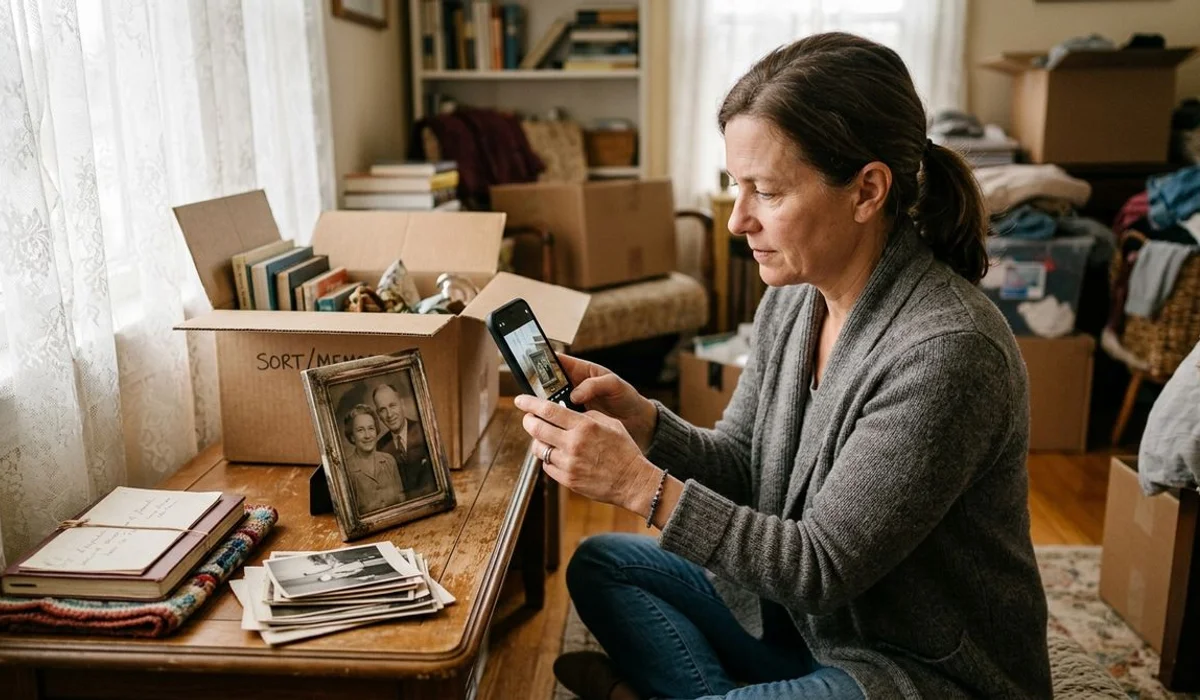
For sentimental items an older adult cannot physically take with them, such as an antique china cabinet or heavy woodworking tools, photograph each item before letting it go. The photos become an accessible digital album. Our team often sees that the first few items resist this process, but a comfortable rhythm usually starts by the tenth photograph.
We also recommend sending older media out for professional conversion if you have large boxes of physical photo albums. Companies like Legacybox and ScanCafe provide highly rated mail-in services in the US.
| Digitization Service | Best For | 2026 Pricing Model |
|---|---|---|
| Legacybox | Mixed media and simple mail-in kits | Starts at $69 for a basic item package |
| ScanCafe | Bulk physical photo conversion | Roughly $0.48 per standard image scan |
The visual memory persists, but the physical volume completely disappears.
Including the Senior in Every Decision
We strongly advise including the older adult in every category transition to preserve their sense of autonomy. Making decisions on their behalf, even with good intentions, often creates lasting resentment and emotional distress.
The temptation during a downsize is to secretly throw things away to save them from stress. Do not do this. A 2026 report from Grow Therapy highlights that 39% of grieving Americans experience feelings of numbness or disconnection.
Our professional organizers emphasize that stripping a person of their choices during a major transition severely exacerbates this psychological toll. The relational damage from items disappearing without their input will easily outlast any timeline savings you might gain.
We recommend adjusting your approach to fit their energy levels:
- Schedule much shorter, 30-minute sorting sessions
- Focus on low-sentiment items during low-energy days
- Take frequent breaks to review progress together
Skipping their input entirely is never the right solution.
Decision Frameworks for Edge Cases
We rely on specific frameworks to handle the most difficult edge cases during a downsize. Emotional attachments require structured guidelines to prevent a project from stalling entirely.
Items Belonging to a Deceased Spouse
We usually advise clients to keep items belonging to a deceased spouse, even if the practical use is minimal. The unresolved grief often sits entirely within those specific objects.
The American Psychiatric Association estimates that up to 10% of bereaved adults experience Prolonged Grief Disorder. Our experience shows that forcing a senior to discard a late spouse’s belongings can trigger intense emotional distress. Keeping these items is often a necessary accommodation for their mental health.
Children’s Artwork and School Projects
We recommend photographing the entire collection of children’s artwork rather than keeping every physical piece. You can keep three to five representative pieces that hold the most meaning.
Once the selected pieces are secured, distribute the rest of the collection directly to the grown children’s families. This method honors the creative output without turning an assisted living apartment into a storage unit.
Books and Reading Materials
Our strategy for books is to keep only absolute favorites and whatever the senior is currently reading. Large libraries are notoriously heavy and difficult to transport to a new space.
You can donate the rest of the collection to local US libraries or specific 501(c)(3) book partners. Organizations like the Prison Book Program or Little Free Library are excellent places to distribute literature. Giving books to these established charities ensures they provide continued value to the community.
Family-History Documents
We handle family-history items, such as military records, immigration documents, and vintage photographs, by digitizing them immediately. You can then distribute these digital copies among all the children or relatives.
Keep the physical originals only when one specific family member agrees to take permanent custody of them. This ensures the historical record remains intact without burdening the downsizing senior.
Signs the Project Needs Outside Help
We closely monitor downsizing projects for clear indicators that professional intervention is required. Recognizing these warning signs early can save your family from unnecessary emotional damage and financial delays.
If you notice any of the following issues, it is time to reassess your approach:
- Sorting stalls for more than two weeks at any phase
- Family arguments and tension are actively increasing
- The senior is showing clear signs of distress or withdrawal
- The target move-out timeline is severely at risk
When these roadblocks appear, a compassionate cleanup provider or specialized move manager often unblocks the project in ways family members cannot. A third-party provider is not carrying decades of complex relationship history. Our teams routinely step into these exact situations to absorb the friction and keep the transition moving smoothly.
For help managing the broader timeline of the move, see the full senior downsizing checklist. Reach out to a professional coordinator today if your compassionate downsizing sort requires immediate support.